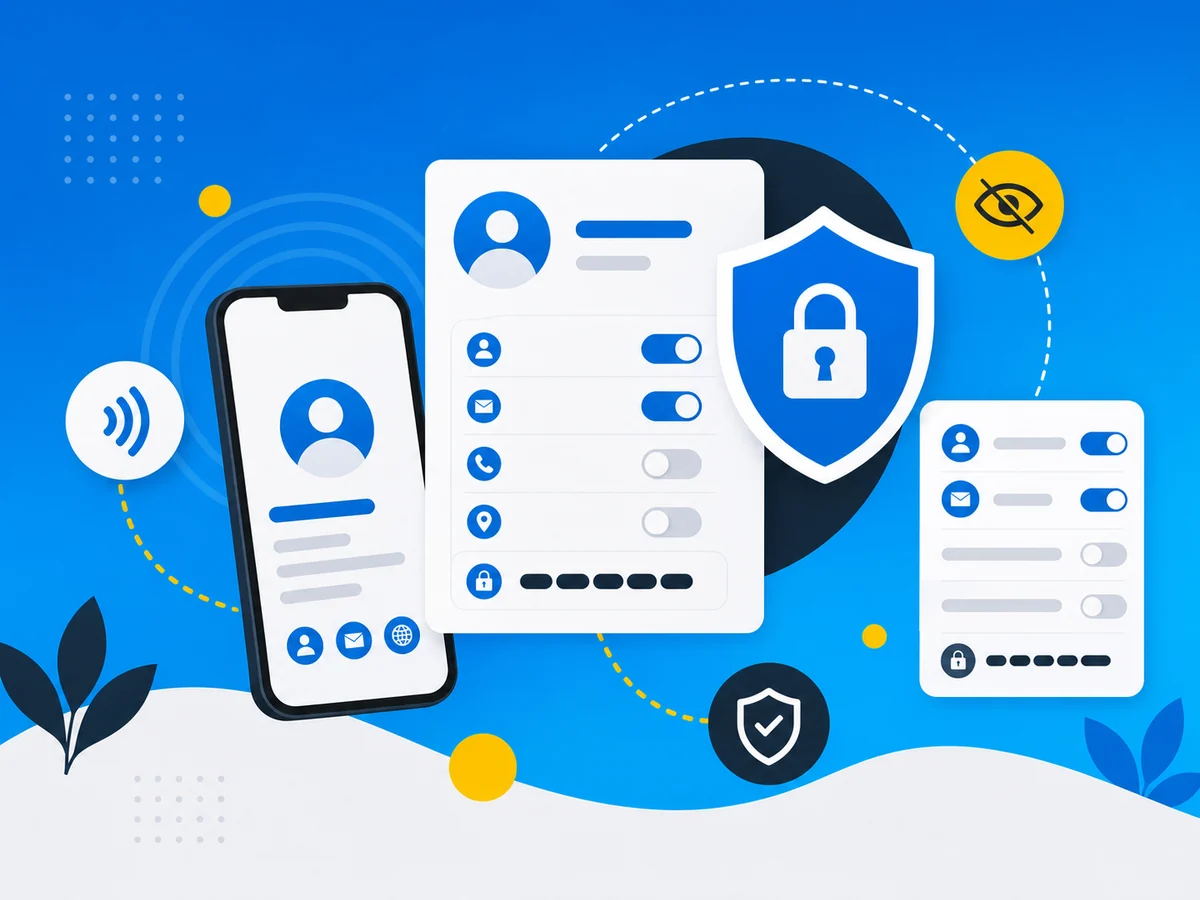
Think about what’s on your business card. Your full name. Your email address. Your phone number. Maybe your office address, your LinkedIn profile, your company name and title.
Now think about this: when you share a digital business card, you’re not just handing someone a piece of cardboard. You’re giving a platform access to that data - and to data about the person you’re sharing it with.
Most digital business card apps collect information about both sides of the exchange. Who shared, who viewed, when, where, on what device, for how long. Some go further than you’d expect.
This isn’t a scare piece. Digital business cards are genuinely better than paper - for networking, for the environment, for keeping your info up to date. But not all platforms treat your data with the same care, and most people never think to ask.
You should.
What Actually Happens When You Share a Digital Business Card?
Here’s the typical flow when someone taps your NFC card or scans your QR code:
Their phone opens a URL hosted by the platform
The platform serves your contact information
The platform logs the interaction - at minimum, a timestamp
Depending on the platform, it may also capture: the viewer’s IP address, device type, browser, approximate location, time spent on your card, which links they tapped
That’s the baseline. Some platforms do more.
Recipient Solicitation
Several digital business card platforms - especially on their free tiers - will market to the people who view your card. Meaning: someone scans your QR code to get your email, and then the platform sends them promotional emails about signing up.
You didn’t ask for that. The person who viewed your card definitely didn’t ask for it. But it happens because the platform needs to grow, and your contacts are free leads.
Not every platform does this. But enough do that it’s worth checking before you sign up.
Conversation Recording
This one might surprise you. Some platforms now offer AI-powered notetaking features that record in-person conversations. The pitch is appealing: meet someone at a conference, tap record, and let AI capture the key points automatically.
The problem is consent. In many jurisdictions - including most of the EU under GDPR and over a dozen US states with two-party consent laws - recording a conversation without the other person’s knowledge or explicit consent is illegal. Even where it’s technically legal, secretly recording a networking conversation raises serious ethical questions.
The person you just met thinks they’re having a friendly chat. They don’t know your phone is transcribing everything they say and uploading it to a cloud server.
Data Enrichment
Some platforms offer “AI contact enrichment” - you scan a business card or exchange contacts, and the platform automatically pulls in additional data from public sources: LinkedIn profiles, company info, social media accounts.
Convenient? Sure. But it means the platform is building a profile of the people you meet, often without their knowledge. Your contacts didn’t sign up for this. They shared their business card, not their entire digital footprint.
The Hidden Cost of “Free”
Many digital business card platforms offer generous free tiers. That’s great for accessibility, but it raises an important question: how does a free product make money?
The honest answers vary:
Upselling to paid plans - The healthy model. Give away basic features, charge for advanced ones.
Platform branding as advertising - Your card becomes a billboard for the platform. Every share is marketing.
Recipient data harvesting - Your contacts become leads for the platform itself.
Data aggregation - Anonymized (or not) networking patterns sold to third parties.
Not every free plan has hidden catches. Some platforms - like Wave Connect - genuinely offer useful free tiers without soliciting your recipients. Others use “free” as a pipeline to collect contact data at scale.
The rule of thumb: if a platform offers unlimited features for free and doesn’t have a clear business model, your data is the business model.
What to Look for in a Privacy-Respecting Platform
Here’s a practical checklist. You don’t need to audit every line of a privacy policy (though you can). Just ask these questions:
1. Does It Solicit Your Recipients?
When someone views your card, does the platform contact them with marketing? This should be a dealbreaker for most professionals. Your contacts trusted you with their attention, not a random platform.
2. What Data Does It Collect About Viewers?
Basic analytics (how many views) are reasonable. IP addresses, device fingerprinting, and behavioral tracking are not - especially without disclosure. Check if the platform’s privacy policy specifically lists what it collects about card viewers (not just cardholders).
3. Where Is the Data Stored?
This matters especially in Europe. Under GDPR, transferring personal data outside the EU requires specific legal safeguards (Standard Contractual Clauses, adequacy decisions). If your platform stores data in the US without these protections, you may be non-compliant just by using it.
4. Can You Export Your Data?
GDPR gives you the right to data portability - you should be able to download everything the platform has about you. If there’s no export option, that’s a red flag. You should own your contacts, not rent access to them.
5. Can You Actually Delete Your Account?
Not “deactivate.” Delete. With all associated data removed from their servers. Some platforms make this surprisingly difficult, burying it behind support tickets rather than offering a self-service option.
6. Does It Have Access Controls?
Can you set your profile to private? Can you protect it with a PIN? Can you choose which information is visible and to whom? These aren’t enterprise features - they’re basic privacy tools that every platform should offer.
7. Does It Record Audio?
This is newer, but becoming more common in the lead-capture space. If a platform offers conversation recording or AI notetaking, understand the legal implications before you use it. In the EU, recording conversations without all parties’ consent violates GDPR. In the US, laws vary by state.
GDPR and Digital Business Cards: What You Need to Know
If you’re based in Europe - or do business with anyone in Europe - GDPR applies to your digital business card. Here’s what that means in practice:
For you as a cardholder:
You have the right to access, export, and delete your data
The platform needs a lawful basis to process your information
You should know exactly what data is collected and shared
For the people who view your card:
They have rights too - even if they never signed up for the platform
The platform can’t just harvest their data without a legal basis
Collecting IP addresses, device info, and browsing behavior counts as processing personal data under GDPR
For your employer (if using team/enterprise plans):
Your company may be jointly responsible for data processing through the platform
CRM integrations multiply the number of systems handling personal data
Each integration requires its own data processing assessment
The practical takeaway: choose a platform that takes GDPR seriously by default, not one that bolts it on as an enterprise add-on.
Why We Built NFC.cool Business Card With Privacy First
Full disclosure: this is the NFC.cool blog, so we’re going to talk about our approach. But we’ve tried to be honest about the landscape above, and we’ll be honest here too.
When we built NFC.cool Business Card, privacy wasn’t an afterthought or a marketing checkbox. It shaped the product:
PIN-Protected Profiles - You can lock your business card behind a 4-digit PIN with rate-limited attempts. Share your card URL freely, but only let people see your details when you want them to. This is useful for NFC cards you might lose, or for times when you want to control who sees your full contact info.
Public/Private Toggle - Choose exactly which fields are visible. Maybe your phone number is only for close contacts. Maybe your address is private. You control the granularity.
No Conversation Recording - We don’t record audio. Period. We think networking should be built on trust, not surveillance.
No Recipient Solicitation - When someone views your card, they see your card. They don’t get marketing emails from us. Your contacts are yours, not our leads.
No Data Monetization or Advertising - Your vCard and account data are stored on our server to power the service, but nothing is used for advertising or third-party data processing.
GDPR Data Export - On iOS, export your contacts as CSV anytime. No support tickets, no waiting period.
NFC Hardware Freedom - We work with any standard NFC tag. NFC.cool doesn’t sell NFC hardware - you’re free to use any third-party tag you choose, without proprietary tracking you can’t audit.
European Indie Developer - We’re a small team based in Portugal. We don’t have VC investors pushing us to monetize user data for growth metrics. Our incentive is building a product people trust, not maximizing data collection.
We’re not perfect. Analytics and lead capture are currently iOS-only (Android support coming soon). We don’t have CRM integrations or webhooks yet - iOS offers CSV export for getting contacts out. Our marketing budget is a fraction of the bigger players. But our privacy model is something we genuinely believe in, and we think it matters.
A Privacy Checklist for Choosing Your Platform
Before you sign up for any digital business card service, run through this:
✅ No recipient solicitation on your plan tier
✅ Clear privacy policy that specifies what viewer data is collected
✅ Data export available (GDPR right to portability)
✅ Account deletion is self-service, not hidden behind support
✅ Profile visibility controls (public/private toggle, PIN protection)
✅ No mandatory conversation recording features that affect people you meet
✅ GDPR compliance if you do business in Europe (or with Europeans)
✅ Transparent business model - you understand how the platform makes money
If a platform fails more than one or two of these, consider whether the convenience is worth the trade-off.
The Bottom Line
Digital business cards are the future of networking. Paper is wasteful, outdated, and can’t be updated after you hand it out. The benefits are real.
But your business card is your professional identity. It’s the first thing people see when they meet you. The platform you trust with that information should earn that trust - through transparency, through user controls, and through a business model that doesn’t depend on exploiting your data or your contacts’ data.
Privacy isn’t about having something to hide. It’s about having the right to choose what you share, with whom, and on whose terms.
Choose wisely.
Ready to try a privacy-first digital business card? Download NFC.cool Business Card for iPhone or get it on Android inside NFC.cool Tools. App UI and App Clip available in 35 languages.